Go 1.27, or How I Learned to Stop Worrying and Love Generic Methods
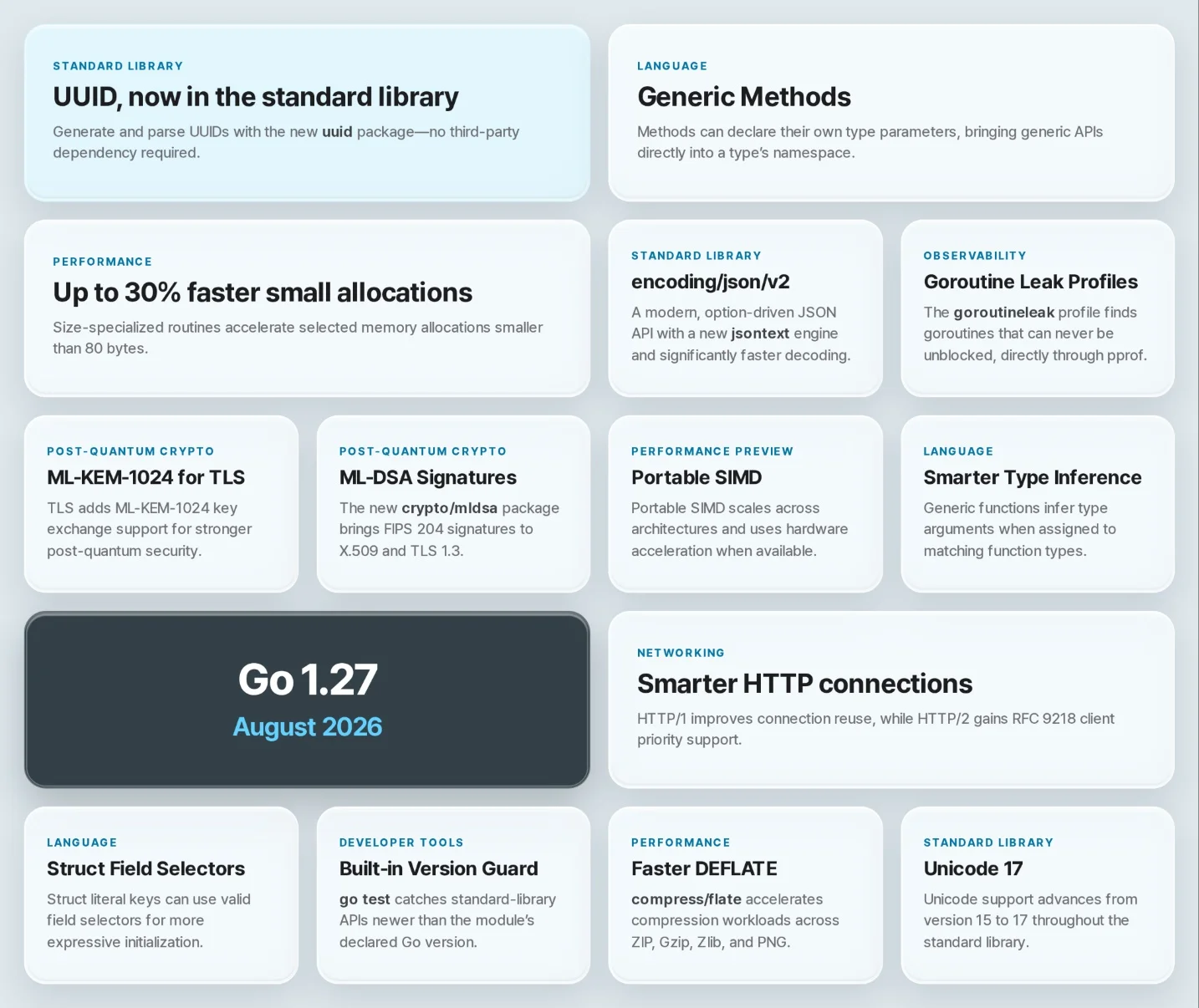
Go 1.27 lands in August 2026, and for once the language itself changed. Not "we added a new function to slices" changed — actually changed. Generic methods are in. An eleven-year-old issue got closed. encoding/json was quietly replaced with a new engine while the plane was in the air.
Every example below was run on go1.27rc3 (darwin/arm64). Every output block is real output, copy-pasted, including the error messages. If something looks weird, it's because that's what the compiler actually said.
1go install golang.org/dl/go1.27rc3@latest
2go1.27rc3 download
1. The Language Changed (Yes, Really)
1.1. Generic Methods
Since Go 1.18 we've had generics, and since Go 1.18 we've had The Conversation. It goes like this:
"Let me just write a
Mapmethod on my slice type—"
method must have no type parameters"...fine. Package-level function it is."
Methods could only use type parameters declared by the receiver. Your own method couldn't introduce new ones. So every generic transformation got exiled to package scope, where it sat next to seventeen other free-floating helpers named some variation of MapSlice.
Go 1.27 fixes this:
 1type List[E any] []E
 2
 3// F is a type parameter declared by the method itself
 4func (l List[E]) Apply[F any](f func(E) F) List[F] {
 5	r := make(List[F], len(l))
 6	for i, x := range l {
 7		r[i] = f(x)
 8	}
 9	return r
10}
11
12func main() {
13	l := List[int]{1, 2, 3}
14	fmt.Println(l.Apply(func(i int) string { return fmt.Sprint(i * 10) }))
15	// [10 20 30]
16}
The receiver doesn't even need to be generic. A boring struct can have a generic method:
1type Bag struct{ items []any }
2
3func (b *Bag) Add[T any](v T) { b.items = append(b.items, v) }
Now, before you refactor your entire codebase this afternoon, there are two restrictions, and they matter more than they look:
- Interface methods cannot declare type parameters.
- Generic methods cannot implement interface methods.
That second one is the one that will bite you:
1type Adder interface{ Add(int) int }
2
3type G struct{}
4
5func (G) Add[T any](v T) T { return v }
6
7var _ Adder = G{}
1cannot use G{} (value of struct type G) as Adder value in variable declaration:
2	G does not implement Adder (wrong type for method Add)
3		have Add[T any](T) T
4		want Add(int) int
So generic methods and dynamic dispatch don't mix. This isn't the Go team being stingy — it's that a generic method has infinitely many instantiations, and an interface method table has to be finite and known at compile time. You can't put an infinite thing in a finite table. The universe said no.
Practical read: generic methods are for concrete types with utility-shaped APIs. Anything that has to hide behind an interface still needs the old approach.
The standard library already took advantage. math/rand/v2's Rand got a generic method:
1func (r *Rand) N[Int intType](n Int) Int
1r := rand.New(rand.NewPCG(1, 2))
2fmt.Println(r.N(int32(100)))     // 76
3fmt.Println(r.N(time.Second))    // 616.436223ms
Previously only the package-level rand.N was generic, which meant using the global source. Now your own seeded *Rand gets the same convenience. Small thing. Nice thing.
1.2. Struct Literal Field Selectors, or: Issue #9859 Finally Gets to Rest
Embedding gives you u.ID. Embedding does not give you User{ID: 1}. Instead it gives you User{Base: Base{ID: 1}}, which is Go's way of asking whether you really meant it.
Issue #9859 was filed in 2015. It has now been closed. Somewhere, a gopher who has since changed careers twice is getting a GitHub notification.
 1type Object struct{ name, color string }
 2type Point3D struct {
 3	Object
 4	x, y, z float64
 5}
 6type Line struct {
 7	Object
 8	p, q Point3D
 9}
10
11// Go 1.27: use the promoted field directly
12line := Line{name: "diagonal", q: Point3D{y: -4, z: 12.3}}
name isn't a field of Line. It's a field of the embedded Object. Previously you'd write Line{Object: Object{name: "diagonal"}, ...}.
Now for the fine print, which I checked by actually trying to compile all of it.
(a) The key is still a plain identifier. You cannot write an arbitrary selector path.
1_ = Line{Object.name: "x"}   // invalid field name Object.name in struct literal
2_ = Line{p.x: 1}             // invalid field name p.x in struct literal
So the feature is not "keys work like field access now." It's specifically "implicitly promoted field names are allowed." Slightly narrower than the headline suggests.
(b) You can't specify an embedded field and something promoted out of it at the same time.
1obj := Object{"edge", "black"}
2_ = Line{Object: obj, name: "diagonal"}
3// cannot specify promoted field name and enclosing embedded field Object
Reasonable. You told it two conflicting things about the same memory and it declined to guess.
(c) Pointer embedding is not invited.
1type PtrEmbed struct {
2	*Object
3	z int
4}
5
6_ = PtrEmbed{name: "x"}
7// invalid implicit pointer indirection to reach name
To follow a pointer you need a pointer to follow, and at literal-construction time there isn't one yet. Also fair.
Good news: go fix will rewrite your old literals for you. More on that later.
1.3. Function Type Inference Got Less Arbitrary
Type inference for generic functions used to work in some places and not others, with no discernible principle behind which was which. Assigning to a variable? Fine. Putting the exact same function in a struct field? Compiler error, please write double[int] like it's 2022.
Go 1.27 makes inference work in every context where the target type is unambiguously known:
 1func double[T ~int | ~float64](v T) T { return v * 2 }
 2
 3type S struct{ f func(int) int }
 4type A [1]func(int) int
 5
 6func main() {
 7	s := S{f: double}          // 1.26: needed double[int]
 8	a := A{double}             // 1.26: needed double[int]
 9
10	c := make(chan func(int) int, 1)
11	c <- double                // 1.26: needed double[int]
12
13	var fn func(float64) float64 = double  // this always worked
14
15	fmt.Println(s.f(21), a[0](5), (<-c)(7), fn(1.5))
16	// 42 10 14 3
17}
One double, instantiated as func(int) int in three places and func(float64) float64 in a fourth, entirely from context. If you write option structs or handler tables full of function values, a bunch of [T] noise is about to vanish from your codebase.
2. Runtime: Free Performance and a Leak Detector
2.1. Size-Specialized Allocation
The compiler now emits calls to size-specialized allocation routines for small objects. The release notes claim up to 30% off allocations under 80 bytes, and about 1% overall for allocation-heavy programs.
I don't believe release notes without measuring, so:
 1type small struct{ a, b, c, d int }
 2
 3var sink any
 4
 5func BenchmarkAlloc(b *testing.B) {
 6	for b.Loop() {
 7		sink = &small{}
 8	}
 9}
10
11func BenchmarkSlice(b *testing.B) {
12	for b.Loop() {
13		sink = make([]byte, 48)
14	}
15}
1# default (size-specialized malloc on)
2BenchmarkAlloc-12     3000000     5.358 ns/op
3BenchmarkSlice-12     3000000    13.58 ns/op
4
5# GOEXPERIMENT=nosizespecializedmalloc
6BenchmarkAlloc-12     3000000     8.722 ns/op
7BenchmarkSlice-12     3000000    20.81 ns/op
8
30–35% faster in a microbenchmark that does nothing but allocate on Apple Silicon. Which is to say: this is the best case, achieved under laboratory conditions by a benchmark designed to make the number look good. In a real program, GC and actual work will bury most of it. The ~1% claim is the honest one.
The cost is binary size. Hello World:
12413202 bytes  (default)
22361826 bytes  (nosizespecializedmalloc)
About 50KB, fixed, regardless of your program. You can opt out with GOEXPERIMENT=nosizespecializedmalloc, but that escape hatch is scheduled for removal in Go 1.28, so treat it as a bug-report workaround rather than a lifestyle.
2.2. The Goroutine Leak Profile Is Real Now
Experimental in Go 1.26, generally available in 1.27. The goroutineleakprofile GOEXPERIMENT is gone; it just works.
 1func leak() {
 2	ch := make(chan int) // nobody will ever send. nobody.
 3	go func() {
 4		<-ch
 5	}()
 6}
 7
 8func main() {
 9	for range 3 {
10		leak()
11	}
12	runtime.GC()
13	runtime.GC()
14	pprof.Lookup("goroutineleak").WriteTo(os.Stdout, 1)
15}
1goroutineleak profile: total 3
23 @ 0x104de3f18 0x104d7f0b0 0x104d7ec34 0x104e374f4 0x104dea024
3#	0x104e374f3	main.leak.func1+0x23	/tmp/go127/leak/main.go:12
Three goroutines, permanently stuck, with a file and line number pointing at exactly where you did it.
The trick behind this is genuinely clever: it reuses the garbage collector's reachability analysis. If goroutine G is blocked on primitive P, and P is unreachable from any runnable goroutine (or anything those goroutines could wake), then nothing can ever touch P again, so G is never waking up. That's not a heuristic — it's a proof.
The same design gives you the limitation for free: if the channel or mutex is reachable through a global, or through a local variable of some goroutine that's still running, the GC can still see it, so the runtime can't conclude anything. Notice that even the toy example above needs two runtime.GC() calls to report. It won't catch everything.
It will, however, catch the classic "forgot to cancel the context, worker goroutine lives forever" — which is most leaks most of the time.
If you import net/http/pprof, it's also at /debug/pprof/goroutineleak. Wire that into staging, check it weekly, be quietly horrified.
This work was contributed by Vlad Saioc at Uber, who deserves a beverage of their choosing.
2.3. Tracebacks Now Tell You Which Request Died
For modules declaring Go 1.27 or later, traceback header lines now include runtime/pprof goroutine labels.
 1func handle(ctx context.Context) {
 2	var wg sync.WaitGroup
 3	wg.Go(func() {
 4		buf := make([]byte, 4<<10)
 5		os.Stdout.Write(buf[:runtime.Stack(buf, true)])
 6	})
 7	wg.Wait()
 8}
 9
10func main() {
11	labels := pprof.Labels("request", "GET /orders/42", "tenant", "acme")
12	pprof.Do(context.Background(), labels, handle)
13}
1goroutine 3 [running] {request: "GET /orders/42", tenant: acme}:
2main.handle.func1()
3	/tmp/go127/tblabel/main.go:15 +0x40
4sync.(*WaitGroup).Go.func1()
5	...
6goroutine 1 [sync.WaitGroup.Wait] {request: "GET /orders/42", tenant: acme}:
7...
The important detail: labels are inherited by child goroutines. Goroutine 3 never set a label. It got one from its parent.
So the next time production deadlocks and someone SIGQUITs the process, instead of 4,000 goroutines that all look identical, you get 4,000 goroutines tagged with which request and which tenant they belong to. Three lines of pprof.Do at your request entry point buys you that.
Since labels can contain things you'd rather not dump to stderr, GODEBUG=tracebacklabels=0 turns it off, and that opt-out is explicitly intended to stick around forever.
2.4. asynctimerchan Is Gone For Good
Go 1.23 made timer channels unbuffered (synchronous) and offered asynctimerchan=1 as a way back to the old behavior. In 1.27, that setting is permanently removed. time package channels are synchronous, full stop, no negotiation.
The interesting part is the policy introduced alongside it. A removed GODEBUG left in your go.mod doesn't automatically break the build — it breaks only if it's set to the old value:
1# go.mod contains: godebug asynctimerchan=1
2go: error loading go.mod:
3go.mod:5: removed GODEBUG "asynctimerchan" set to old value "1" (https://go.dev/doc/godebug#go-127)
4
5# go.mod contains: godebug asynctimerchan=0
6(builds fine)
Which means the only people who get yelled at are the people who were actually relying on the removed behavior. Everyone who set it to the eventual default and forgot about it gets to keep not thinking about it. That's a thoughtful piece of API archaeology.
3. Standard Library
3.1. encoding/json/v2: They Replaced the Engine Mid-Flight
This is the big one. Two-plus years of proposal discussion finally landed.
There are now three packages, and understanding the split is most of the battle:
| Package | Job |
|---|---|
encoding/json | The v1 API you know. Behavior 100% unchanged. Now implemented on top of v2 |
encoding/json/v2 | Semantic processing. Go values ↔ JSON |
encoding/json/jsontext | Syntactic processing. JSON as a token stream |
The headline is that encoding/json was rebuilt on a completely different implementation and behaves identically. Here's how:
1// Go 1.27's encoding/json.Unmarshal, abridged
2func Unmarshal(data []byte, v any) error {
3	return jsonv2.Unmarshal(data, v, DefaultOptionsV1())
4}
Every legacy v1 quirk got encoded as an option, bundled into DefaultOptionsV1(), and the v1 API always applies the bundle. Which means this behaves the same in 1.26 and 1.27:
1var m map[string]int
2json.Unmarshal([]byte(`{"a":1,"a":2}`), &m)  // <nil>, map[a:2]
Yes, v1 still silently accepts duplicate keys and takes the last one. It always did. It still does. Compatibility means compatibility with the bad parts too.
v2, meanwhile, has opinions:
1var m map[string]int
2jsonv2.Unmarshal([]byte(`{"a":1,"a":2}`), &m)
3// jsontext: duplicate object member name "a"
4
5var s string
6jsonv2.Unmarshal([]byte("\"\xff\""), &s)
7// jsontext: invalid UTF-8 after offset 1
Duplicate keys and invalid UTF-8 are rejected. Both are genuinely dangerous, not just untidy — when two parsers disagree about which duplicate key wins, you get security bugs. CouchDB's CVE-2017-12635 was exactly this: a JSON body with two roles keys, where the validator read one and the storage layer read the other. Rejecting is the right call.
Options are variadic:
 1type Config struct {
 2	Name    string   `json:"name"`
 3	Tags    []string `json:"tags,omitzero"`
 4	Timeout int      `json:"timeout,omitzero"`
 5}
 6
 7out, _ := jsonv2.Marshal(Config{Name: "api"})
 8// {"name":"api"}
 9
10// sorted map keys + indentation
11out, _ = jsonv2.Marshal(map[string]int{"b": 2, "a": 1},
12	jsonv2.Deterministic(true), jsontext.WithIndent("  "))
13// {
14//   "a": 1,
15//   "b": 2
16// }
17
18// reject unknown fields — previously required a Decoder and DisallowUnknownFields()
19var c Config
20err := jsonv2.Unmarshal([]byte(`{"name":"api","nope":1}`), &c,
21	jsonv2.RejectUnknownMembers(true))
22// json: cannot unmarshal JSON string into Go main.Config:
23//   unknown object member name "nope"
Deterministic, MatchCaseInsensitiveNames, StringifyNumbers, FormatNilSliceAsNull, OmitZeroStructFields — most of the things you previously solved with a third-party library or a hand-written MarshalJSON are now flags.
And the migration story is the best part. Later options win, so you can adopt v2's strictness one behavior at a time:
1// keep v1 semantics, but reject duplicate keys like v2 does
2jsonv2.Unmarshal(data, &v,
3	json.DefaultOptionsV1(),
4	jsontext.AllowDuplicateNames(false))
5// duplicate object member name
You don't have to port a 200k-line codebase to v2 to stop accepting duplicate keys. You flip one option. For anything large, this is the realistic path.
Performance: marshaling is roughly at parity, unmarshaling is significantly faster. If it goes wrong, GOEXPERIMENT=nojsonv2 restores the old implementation — and that opt-out is also on the chopping block eventually, so file an issue rather than settling in.
jsontext is the low-level layer: Encoder/Decoder walking JSON as Tokens and Values with a state machine keeping you honest. Reach for it when you're writing a streaming transformer or a JSON filter and don't want to materialize Go values at all.
3.2. A Standard uuid Package
At long last. RFC 9562, in the standard library, no go get required.
 1import "uuid"
 2
 3func main() {
 4	fmt.Println(uuid.NewV4())
 5	// b97aa695-da08-472c-af81-ff088129019f
 6
 7	// v7: top 48 bits are a timestamp, so these always sort in creation order
 8	a, b := uuid.NewV7(), uuid.NewV7()
 9	fmt.Println(a.Compare(b) < 0) // true
10
11	u, err := uuid.Parse("urn:uuid:0198a1b2-c3d4-7e5f-8a9b-0c1d2e3f4a5b")
12	fmt.Println(u, err)
13	// 0198a1b2-c3d4-7e5f-8a9b-0c1d2e3f4a5b <nil>
14
15	fmt.Println(uuid.Nil(), uuid.Max())
16	// 00000000-0000-0000-0000-000000000000 ffffffff-ffff-ffff-ffff-ffffffffffff
17}
The whole API is New, NewV4, NewV7, Nil, Max, Parse, MustParse, and one type: type UUID [16]byte. That's it. You can read the entire package documentation while your coffee cools.
Details worth knowing:
UUIDis[16]byte, so==works and it's directly usable as a map key. Same design asgoogle/uuid.NilandMaxare functions, not variables. Because a package-levelvar Nil UUIDis a loaded gun pointed at your foot, and someone, somewhere, would eventually assign to it.- Random bits come from a cryptographically secure generator.
- It implements
encoding.TextMarshaler/TextUnmarshaler/TextAppender, so it drops straight into JSON structs. NewV7is the one you want for database primary keys. Time-ordered means your B-tree index stops fragmenting, which v4 UUIDs are famously bad at.
You can now delete a dependency. If you need v1/v3/v5 or fancier parsing options, third-party libraries still have a job.
3.3. crypto/mldsa: Post-Quantum Signatures, and They're Enormous
Go 1.24 gave us crypto/mlkem for post-quantum key exchange. Go 1.27 brings the other half: ML-DSA signatures, standardized as FIPS 204.
 1sk, _ := mldsa.GenerateKey(mldsa.MLDSA65())
 2pk := sk.PublicKey()
 3
 4msg := []byte("release the gophers")
 5opts := &mldsa.Options{Context: "gosuda.org/blog"}
 6
 7sig, _ := sk.Sign(rand.Reader, msg, opts)
 8
 9fmt.Println("private key seed:", len(sk.Bytes()), "bytes")  // 32
10fmt.Println("public key:", len(pk.Bytes()), "bytes")        // 1952
11fmt.Println("signature:", len(sig), "bytes")                // 3309
12
13fmt.Println(mldsa.Verify(pk, msg, sig, opts))
14// <nil>
15fmt.Println(mldsa.Verify(pk, msg, sig, &mldsa.Options{Context: "other"}))
16// mldsa: invalid signature
Look at those numbers. A single signature is 3,309 bytes. Ed25519 is 64. That's a 50x increase, and the public key is nearly 2KB on top of it. Stuff a few of these into a certificate chain and your TLS handshake starts needing its own MTU strategy.
This is the actual cost of quantum resistance today, and it's why nobody is switching everything over tomorrow. But it's in the standard library now, which is where you want it to be before you need it.
Options.Context is domain separation: sign with the same key for different purposes, use a different context for each, and a signature from one context won't verify in another. The example above shows exactly that — same key, same message, different context, rejected.
PrivateKey implements crypto.Signer, so it slots into existing interfaces. crypto/x509 handles ML-DSA keys and signatures, and crypto/tls supports the MLDSA44/MLDSA65/MLDSA87 signature schemes in TLS 1.3.
There's also SignDeterministic, which skips the randomness — handy for tests and reproducible builds.
3.4. simd: Vector Instructions Without the Assembly
Go 1.26 introduced the architecture-specific simd/archsimd as an experiment. Go 1.27 adds simd — portable and vector-width-agnostic. Enable with GOEXPERIMENT=simd.
 1// dst = a*x + y
 2func axpy(dst, x, y []float32, a float32) {
 3	va := simd.BroadcastFloat32s(a)
 4	w := va.Len()
 5
 6	i := 0
 7	for ; i+w <= len(x); i += w {
 8		vx := simd.LoadFloat32s(x[i:])
 9		vy := simd.LoadFloat32s(y[i:])
10		vx.MulAdd(va, vy).Store(dst[i:])
11	}
12	// handle the tail with a partial load/store — no scalar cleanup loop
13	if i < len(x) {
14		vx, _ := simd.LoadFloat32sPart(x[i:])
15		vy, _ := simd.LoadFloat32sPart(y[i:])
16		vx.MulAdd(va, vy).StorePart(dst[i:])
17	}
18}
1$ GOEXPERIMENT=simd go1.27rc3 run ./simddemo
2vector bits: 128 emulated: false
3[4 7 10 13 16 19 22 25 28 31]
The design choice that matters: the vector width is never hardcoded. You ask va.Len() at runtime. VectorBitSize() tells you the actual width, Emulated() tells you whether you got real hardware or a polite software impersonation. My Mac reported 128-bit NEON; an AVX-512 machine reports more; a machine with nothing reports emulation and the code still runs.
LoadFloat32sPart/StorePart deserve special mention. The most annoying part of hand-written SIMD is always the ragged tail at the end of the array, and this handles it without a separate scalar loop.
Still experimental, API still unstable, do not put it in production. But the fact that this is Go code and not assembly or cgo is a genuinely big deal.
3.5. hash/maphash.Hasher
A new interface describing the contract between a value type and hash-based containers:
1type Hasher[T any] interface {
2	Hash(*Hash, T)
3	Equal(x, y T) bool
4}
Why? Go's builtin map only accepts comparable keys. You can't key on a slice. You can't define "equal ignoring case." Hasher solves both at once:
 1type CaseInsensitive struct{}
 2
 3func (CaseInsensitive) Hash(h *maphash.Hash, s string) {
 4	h.WriteString(strings.ToLower(s))
 5}
 6func (CaseInsensitive) Equal(x, y string) bool {
 7	return strings.ToLower(x) == strings.ToLower(y)
 8}
 9
10var seed = maphash.MakeSeed()
11
12func hashOf[T any](hr maphash.Hasher[T], v T) uint64 {
13	var h maphash.Hash
14	h.SetSeed(seed)   // same seed, or none of this means anything
15	hr.Hash(&h, v)
16	return h.Sum64()
17}
18
19fmt.Println(hashOf(CaseInsensitive{}, "Go") == hashOf(CaseInsensitive{}, "GO"))
20// true
For ordinary == semantics there's ComparableHasher[T]:
1hashOf(maphash.ComparableHasher[int]{}, 42)
The catch: Hasher is an interface, not a data structure. There is no standard hash table or Bloom filter that consumes it yet. This is groundwork for a future container package. Today you'd use it when building your own structure, or consume an existing implementation like go/types.Hasher (which lets you use types.Type as a map key, respecting Identical).
Seed management is on you. If hashOf above made a fresh seed each call, identical values would hash differently and the example would print false — which is exactly the bug I wrote on my first attempt. One seed per container. (The seed is randomized to defeat hash-flooding DoS attacks, which is why it isn't just a constant.)
3.6. httptest.NewTestServer + synctest.Sleep: The Sleeper Hit
If you only adopt one thing from this release, make it this one.
testing/synctest graduated in Go 1.25 and gave us a fake clock for testing concurrent code. Except the moment your test touched a real network, the illusion collapsed. Go 1.27's httptest.NewTestServer uses an in-memory fake network, so the bubble stays intact. And synctest.Sleep (= time.Sleep + synctest.Wait) rounds it out.
Here's a retry-with-exponential-backoff test:
 1func TestRetryWithBackoff(t *testing.T) {
 2	synctest.Test(t, func(t *testing.T) {
 3		var hits int
 4		srv := httptest.NewTestServer(t, http.HandlerFunc(
 5			func(w http.ResponseWriter, r *http.Request) {
 6				hits++
 7				if hits < 3 {
 8					w.WriteHeader(http.StatusServiceUnavailable)
 9					return
10				}
11				io.WriteString(w, "ok")
12			}))
13
14		client := srv.Client()
15		start := time.Now()
16		var body string
17		for attempt := range 5 {
18			resp, err := client.Get(srv.URL)
19			if err != nil {
20				t.Fatal(err)
21			}
22			b, _ := io.ReadAll(resp.Body)
23			resp.Body.Close()
24			if resp.StatusCode == http.StatusOK {
25				body = string(b)
26				break
27			}
28			synctest.Sleep(time.Duration(1<<attempt) * time.Second)
29		}
30
31		if body != "ok" {
32			t.Fatalf("got %q", body)
33		}
34		// backoff should be exactly 1s + 2s = 3s
35		if elapsed := time.Since(start); elapsed != 3*time.Second {
36			t.Fatalf("elapsed = %v, want 3s", elapsed)
37		}
38		t.Logf("hits=%d elapsed=%v", hits, time.Since(start))
39	})
40}
1=== RUN   TestRetryWithBackoff
2    x_test.go:48: hits=3 elapsed=3s
3--- PASS: TestRetryWithBackoff (0.00s)
Read that twice. It simulated three seconds of backoff against a real HTTP server, and finished in 0.00 seconds. And the assertion is elapsed == 3*time.Second — exactly three seconds, not "at least three seconds, give or take scheduler jitter." Fake clocks don't jitter.
synctest.Sleep exists for a specific reason: if your test sleeps for the same duration as the code under test, which one wakes up first is anybody's guess. synctest.Sleep sleeps and then waits until every other goroutine in the bubble is durably blocked, so you observe the system after it has settled.
Timeouts, retries, circuit breakers, rate limiters — every time-dependent HTTP client test you own can become fast and deterministic. If your test suite is currently held together with time.Sleep(100 * time.Millisecond) and hope, this is your exit.
3.7. net/http Changes That Actually Affect Production
Quiet, but they'll show up in your metrics.
HTTP/1 response bodies auto-drain on Close. Unread content is now drained (up to a conservative limit) when you close the body, so the connection can be reused. Which means you can finally delete this incantation that everyone has copy-pasted from the same Stack Overflow answer since 2016:
1// no longer necessary
2defer func() {
3	io.Copy(io.Discard, resp.Body)
4	resp.Body.Close()
5}()
For most programs this is a no-op or a small win. If it makes things worse, you're probably in the bucket the release notes politely describe: Transport.MaxIdleConns set to 0, or a new Client per request, bypassing the idle connection limit entirely. Transport.DisableKeepAlives = true will paper over it, but the release notes' actual advice is that "a deeper look would likely be beneficial," which is Go-team for you have bigger problems.
HTTP/2 client priority (RFC 9218). The server now honors client priority signals. If you preferred the old round-robin scheduling, Server.DisableClientPriority = true.
Server.MaxHeaderValueCount. Caps how many header values the server will accept, defaulting to DefaultMaxHeaderValueCount. One more door closed on "send ten thousand headers and watch what happens."
ALPN on user-provided conns. If your net.Conn implements ConnectionState() tls.ConnectionState, Transport and Server will do TLS ALPN negotiation on it — so custom dialers going through a proxy can still negotiate HTTP/2.
3.8. The Small Stuff That Sparks Joy
strings.CutLast / bytes.CutLast. Cut splits at the first separator. There was no "last" variant, so everyone hand-rolled LastIndex plus slicing, and roughly 30% of us got an off-by-one on the first try.
1name, ext, ok := strings.CutLast("archive.tar.gz", ".")
2// archive.tar gz true
Great for file extensions and for parsing host:port — where you must find the last colon, because IPv6 addresses are full of them.
math/big.Int.Divide. Division with an explicit rounding mode, replacing the "is it Quo or Div I want?" coin flip:
1x, y := big.NewInt(-7), big.NewInt(2)
2
3new(big.Int).Divide(x, y, new(big.Int), big.Trunc)  // q=-3 r=-1
4new(big.Int).Divide(x, y, new(big.Int), big.Floor)  // q=-4 r=1
5new(big.Int).Divide(x, y, new(big.Int), big.Round)  // q=-4 r=1
6new(big.Int).Divide(x, y, new(big.Int), big.Ceil)   // q=-3 r=-1
If you work in a domain where the rounding rule is written down in a regulation, this is for you.
url.URL.Clone and url.Values.Clone. Deep copies. The old *u shallow copy shared the Userinfo pointer, which produced exactly the kind of bug that takes a day to find and five seconds to fix.
1orig, _ := url.Parse("https://gosuda.org/blog?tag=go&tag=1.27")
2clone := orig.Clone()
3clone.Host = "example.com"
4fmt.Println(orig.Host, clone.Host)  // gosuda.org example.com
net.UnixConn read methods now return io.EOF directly instead of wrapping it in net.OpError. err == io.EOF works now, as it always should have.
database/sql.ConvertAssign and driver.RowsColumnScanner. Driver-author features. The first exposes the type conversions Rows.Scan performs; the second lets drivers scan straight into user destinations, skipping an intermediate allocation.
unicode 15 → 17. Two versions in one jump. String classification and normalization behavior may shift subtly. If you have tests that depend on it, you'll find out.
compress/flate got faster — and its output bytes may differ from Go 1.26. This cascades to archive/zip, compress/gzip, compress/zlib, and image/png. If you have golden-file tests that hash compressed output, they are going to break, and it will not be a regression. Check for this before you upgrade, not during the incident review.
4. Toolchain
4.1. go fix Grew More Modernizers
go fix is quietly turning into a code modernization tool. Go 1.27 adds atomictypes, embedlit, slicesbackward, and unsafefuncs. Use -diff to preview:
 1package fixdemo
 2
 3import (
 4	"sync"
 5	"sync/atomic"
 6)
 7
 8type Base struct{ ID int }
 9type User struct {
10	Base
11	Name string
12}
13
14func New() User {
15	return User{Base: Base{ID: 1}, Name: "gopher"}
16}
17
18var counter int64
19
20func Incr() { atomic.AddInt64(&counter, 1) }
21
22func Reverse(s []string) {
23	for i := len(s) - 1; i >= 0; i-- {
24		_ = s[i]
25	}
26}
27
28func Spawn(wg *sync.WaitGroup) {
29	wg.Add(1)
30	go func() {
31		defer wg.Done()
32	}()
33}
1$ go1.27rc3 fix -diff ./fixdemo
 1 import (
 2+	"slices"
 3 	"sync"
 4 	"sync/atomic"
 5 )
 6
 7 func New() User {
 8-	return User{Base: Base{ID: 1}, Name: "gopher"}
 9+	return User{ID: 1, Name: "gopher"}
10 }
11
12-var counter int64
13+var counter atomic.Int64
14
15-func Incr() { atomic.AddInt64(&counter, 1) }
16+func Incr() { counter.Add(1) }
17
18 func Reverse(s []string) {
19-	for i := len(s) - 1; i >= 0; i-- {
20-		_ = s[i]
21+	for _, v := range slices.Backward(s) {
22+		_ = v
23 	}
24 }
25
26 func Spawn(wg *sync.WaitGroup) {
27-	wg.Add(1)
28-	go func() {
29-		defer wg.Done()
30-	}()
31+	wg.Go(func() {
32+	})
33 }
Four modernizers fired on one small file:
embedlit— rewrites embedded literals using the new syntax from §1.2atomictypes—atomic.AddInt64(&x, 1)becomesatomic.Int64.Add(1), which makes non-atomic access impossible and quietly fixes 32-bit alignment bugs you didn't know you hadslicesbackward— backward loops becomeslices.Backwardwaitgroupgo— theAdd/go/Doneritual becomeswg.Go(renamed from 1.26'swaitgroupto avoid ambiguity)
go tool fix help lists all 26; go tool fix help <name> explains one. Also, fmtappendf was removed "due to stylistic concerns," which is a beautifully diplomatic way to describe whatever happened in that issue thread.
Running go fix ./... on an old codebase is a genuinely satisfying afternoon. Read the diff first, obviously.
4.2. go test Runs stdversion by Default
This is the change most likely to interrupt your day.
go test now runs the stdversion vet check by default, flagging standard library symbols newer than your go.mod's go directive allows:
1// go.mod says: go 1.24
2package sv
3
4import "strings"
5
6func Ext(name string) string {
7	_, ext, _ := strings.CutLast(name, ".")  // CutLast is a 1.27 symbol
8	return ext
9}
1$ go1.27rc3 test ./...
2# sv
3./x.go:6:23: strings.CutLast requires go1.27 or later (module is go1.24)
4FAIL	sv [build failed]
This kills the classic failure mode where everything works on your machine (latest toolchain) and explodes in CI or in a user's older environment. If you publish libraries with a conservative go directive, this is a gift.
4.3. go test -json Gained OutputType
"Action":"output" lines now carry an optional "OutputType" field: "error", "error-continue", or "frame".
1'frame'  '=== RUN   TestFail\n'
2None     '    x_test.go:6: hello\n'
3'error'  '    x_test.go:7: boom\n'
4'frame'  '--- FAIL: TestFail (0.00s)\n'
5'frame'  'FAIL\n'
t.Log output (no field), t.Error output (error), and framework-generated lines (frame) are now distinguishable. Anyone who has written a regex to figure out which lines of test output are "real" can now delete it.
4.4. go doc Improvements
package@version syntax. Read the docs for a specific version without adding it to your module:
1$ go1.27rc3 doc golang.org/x/sync/errgroup@v0.10.0
2package errgroup // import "golang.org/x/sync/errgroup"
3...
Handy for checking what changed before an upgrade.
-ex and example source printing:
 1$ go1.27rc3 doc -ex strings | grep Example
 2    func ExampleClone()
 3    func ExampleCompare()
 4    func ExampleContains()
 5    func ExampleCut()
 6    func ExampleCutPrefix()
 7    ...
 8
 9$ go1.27rc3 doc strings.ExampleCut
10package main
11
12import (
13	"fmt"
14	"strings"
15)
16
17func main() {
18	show := func(s, sep string) {
19		before, after, found := strings.Cut(s, sep)
20		fmt.Printf("Cut(%q, %q) = %q, %q, %v\n", s, sep, before, after, found)
21	}
22	show("Gopher", "Go")
23	...
24}
25
26Output:
27Cut("Gopher", "Go") = "", "pher", true
Example source and expected output, in the terminal, without opening a browser tab that will still be open next Thursday.
4.5. go mod tidy Cleans Up Your require Blocks
For modules on go 1.27 or later, go mod tidy merges scattered require blocks into at most two (direct and indirect), preserving attached comments.
 1// Before
 2module tidydemo
 3
 4go 1.27
 5
 6require golang.org/x/sync v0.10.0
 7
 8// networking
 9require golang.org/x/net v0.33.0
10
11require (
12	golang.org/x/sys v0.28.0 // indirect
13)
14
15require golang.org/x/text v0.21.0 // indirect
 1// After: go mod tidy
 2module tidydemo
 3
 4go 1.27
 5
 6require (
 7	// networking
 8	golang.org/x/net v0.33.0
 9	golang.org/x/sync v0.10.0
10)
Note that the // networking comment survived. This mostly cleans up after Git merge conflict resolution, which is where stray require blocks are born. If your team has more than three people adding dependencies, your go.mod conflicts are about to get noticeably quieter.
4.6. Odds and Ends
bzrsupport removed. If this affects you, I'd genuinely like to hear the story.go tool trace -httpbinds to localhost when given only a port.-http=:6060no longer listens on every interface. Use-http=0.0.0.0:6060if you meant it. This now matchesgo tool pprof, and prevents the occasional accidental public profiler.- Response files (
@file) are supported bycompile,link,asm,cgo,cover, andpack, in a GCC-compatible format. For build systems that blow past command-line length limits — hello, Bazel.
5. Compiler, Linker, Ports
Compiler. Relative filenames in //line directives now resolve against the directory of the containing file, matching go/scanner. Relevant if you write code generators.
Function literal (closure) symbol names are also simpler now — the same name regardless of inlining, and multiple instances of the same literal may share code in the binary. No functional change, except: code that compares function identity via reflect.Value.Pointer will see "equal" more often than before. That comparison was never valid, but if you have it, now is when it starts lying to you louder.
Linker. New -macos and -macsdk options set the OS and SDK versions in the macOS LC_BUILD_VERSION load command.
Ports.
- Darwin now requires macOS 13 Ventura or later, as announced in 1.26. Go check your CI runners.
- PowerPC (
GOOS=linux GOARCH=ppc64) switched to the ELFv2 ABI. Requires Linux kernel 3.13+ (RHEL7 backported to 3.10). Cgo, PIE, and external linking are now supported. If you use cgo but need a static pure-Go binary, setCGO_ENABLED=0.
6. Upgrade Checklist
Go 1.27 takes compatibility seriously, but check these before you bump the version:
- Golden-file tests on compressed output.
compress/flatechanged encoders; gzip/zip/png bytes may differ. - Tests matching JSON error message strings. Behavior is identical; the error text is not.
- Removed GODEBUGs in
go.mod.asynctimerchan,gotypesalias,tlsrsakex,tls3des,tls10server,tlsunsafeekm,x509keypairleaf— these fail the build only if set to their old values. -
stdversionviolations.go testcatches these now. Run it early if you maintain a library with a conservativegodirective. - macOS 12 or older CI runners. Support is gone.
- Tests asserting on function literal symbol names, and
reflect.Value.Pointerfunction comparisons. -
Transport.MaxIdleConns = 0or aClientper request. Combined with auto-draining response bodies, this may get slower.
Closing Thoughts
Go 1.27 is the release where a lot of deferred maintenance came due at once.
Generic methods were the missing piece of the 1.18 generics work. Struct literal field selectors closed an eleven-year-old issue. encoding/json/v2 was two years of proposal discussion. And uuid filled a hole that basically every Go project had been patching with the same third-party dependency for a decade.
If you want a priority order for actually getting value out of this:
httptest.NewTestServer+synctest.Sleep— time-dependent HTTP tests become fast and deterministic. Best effort-to-payoff ratio in the entire release.- The goroutine leak profile — expose one endpoint in staging and prepare to be humbled.
- Traceback goroutine labels — three lines of
pprof.Doat your request entry point turns your next 3 AM stack dump into something readable. go fix ./...— let the tool do the modernization.encoding/json/v2— no rush. Adopt it one option at a time.
Grab go1.27rc3 and run your test suite against it now. Everything on that checklist is significantly more pleasant to discover on a Tuesday afternoon than during an incident.
References